
Learning from Other Authors: The Good and the Bad

You guys, I cannot stress enough how important it is for you to read consistently if you want to improve your writing. I’m of the opinion that being part of a critique group is the absolute best way to improve your writing as quickly and as reliably as possible. However, if you are not part of a critique group (and even if you are in one), you should read on a consistent basis to gain knowledge about how to improve your storytelling or prose or character development or anything else that goes into making a good book. If you never improve, you’re likely to start losing your edge, and you may not even realize it until someone edits your new manuscript.

This was a lesson I had been told year after year by writer friends, but I never truly took them seriously. I worried that if I read outside my genre, I would get bored and DNF the book. I also feared if I read too often, other people’s work would influence my stories in a way that would make them feel devoid of my style. However, it was only after I started reading consistently for the first time since high school that I gained a new perspective on why we should read other’s work.

Sometimes, we choose to revisit a book we loved in junior high/high school, and sometimes as we’re reading it, we see things we did not see before, and it’s not looking good. Suddenly, someone you used to praise as your favorite author is someone who’s books you can barely stand, and you learn what not to do when writing your own stories. This happened to me earlier this year. And then it happened again…and again…all with different book series from the same author.

The most disheartening part is this author is self-published, like me, and several of her books did not list an editor of any kind. However, that hardly seemed to make any difference as even books that did have an editor were still riddled with typos and other issues. I have never in my life thought I would read a book with over 200 typos in it (yes, I counted), among storytelling missteps, and inaccuracies in the book’s own worldbuilding. I don’t want to end up publishing something like that, and I doubt any of you want to either. I would be mortified.

I knew when I started to reread this author’s books that I would not find them as engaging as I once did when I was a teen, but I did not expect to find myself constantly being taken out of the story due to the numerous plot holes, out-of-character decisions, unlikeable characters who were meant to be likeable, and typos and formatting errors. It was exhausting to get through, but at the same time I wanted to stick it out because there were still moments I truly loved that I think this author did very well. As of writing this, the author has self-published four series and is working on their fifth. I managed to read through three of her four finished series, but I cannot continue without some kind of palate cleanser. Maybe once I’m feeling more refreshed I will finish what I started.

One thing I will always praise this author for is their imaginative premises, which often outshine the plots that rise from them. They draw heavy inspiration from old fairy tales, like those of the brothers Grimm, stories from other European countries, and various mythologies. I can tell this author has a passion for what they write, but I wish they would have invested more time into polishing their books before putting them out on the market. Every single one of her books reads like a first draft, not a finished story. I learned a very valuable lesson from revisiting these teen favorites. They still hold a special place in my heart, and now I have a new appreciation for them because I can see how much I’ve grown in my own craft thanks to my critique group.

Revisiting these series was a journey in and of itself. As I continue to revisit old favorites and dive into new books on my To-Read List, I hope to nourish my writing with new insights and ideas from talented, beloved authors. Dear reader (and writer!), thank you so much for your stay here! I hope you too will flourish in your writing by reading others’ work. Have a great one, and I’ll see you soon!
Is Anything Original Anymore?

Every writer knows the crushing feeling that comes after you’ve explained your next writing project only for someone to respond with, “Oh, so it’s like ___!” It makes you defensive, because you know you came up with that idea on your own, right? There’s no way someone else had the exact same idea as you before, right?

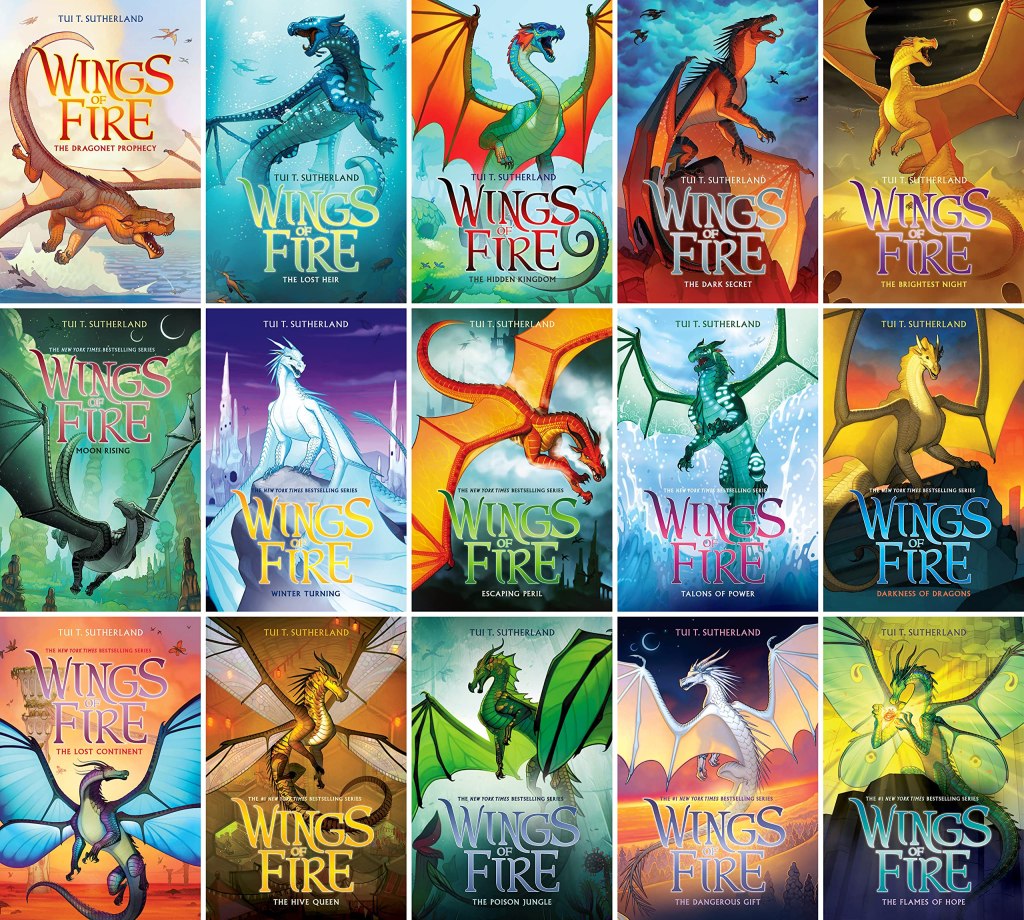
Here’s the thing: nothing is original anymore. Every piece of media is inspired by something else, but I’m sure you know that already. There’s no avoiding it, and I’ve been through it countless times before. One of my favorite authors is Tui T. Sutherland, who wrote the Wings of Fire series. There were pieces of her books that greatly inspired the worldbuilding in my novel and the sequels-to-come, but I began to notice something strange. I would be writing a plot point in Escapade and when Tui’s newest Wings of Fire book came out I would read it immediately, only to find that the very plot point I had just been writing days before was present in this new book. And it just kept happening. It was the oddest coincidence, and it helped me see that sometimes, writers just come up with similar storylines. Afterall, those storylines must be good if they get used so often.

Now it doesn’t bother me when someone compares my stories to other pieces of media. They’re not being malicious. They’re just trying to make a connection with you by showing you that they understand what your story is. But that’s not the main reason I’m writing this. I brought this up, dear reader/writer, because I wanted to remind you that it is perfectly okay to draw inspiration from other media. That doesn’t mean you should copy or plagiarize. All I’m saying is inspiration has a funny way of turning something you loved watching/reading/ listening to into something that fits your style.

When people ask me what my book is about, I want them to know about the plot, but also I want them to be aware of the story’s tone and emotional beats. In order to keep from rambling, I end up just saying, “Oh, it’s like if you mixed Robin Hood, Tarzan, and the Swan Princess and set it in a fantasy world where dragons are sapient beings, just like humans!”

<~> And, hint hint, this is also a good marketing strategy, because chances are someone could see what inspired your story and say, “Hey, I like those things, so I’ll probably like this book, too!” <~>

Obviously, I drew inspiration from a lot of other pieces of media for individual characters, settings, storylines, and more, but that would be too much to go into. Just know that Escapade‘s DNA is complex and even I forget everything that inspired its creation. My protagonist, Fendrel, alone was inspired by so many little things that it’s hard to keep track of how I developed him from first draft to the final published work.

Inspiration is such an amazing feeling and I wish I could feel it more often. When I do, it hits like a drug. It makes me want to sit down with my keyboard and write until my stream of consciousness has run out of words. Sometimes it comes on suddenly by watching a certain movie, and other times I can induce the feeling by listening to a particular song.

<~> I’m a huge fan of different genres of music, and making playlists for individual characters or for the story as a whole is a fantastic way to get me excited about writing again! You should try it out, if you haven’t before. <~>

But what do you all do when you need to be inspired? Do you go outside or watch a comfort movie/show? Do you watch video essays of people talking about something that fuels their passion for storytelling? I’m curious to know!

Thank you for staying, dear reader! Happy writing if you write, and happy reading for all (seriously, though, if you’re a writer you NEED to read in order to keep your skills sharp). I hope you all have a great one!

I Thought I Was a “Pantser”

***SPOILERS for my debut novel, The Dragon Liberator: Escapade***

One of the things I learned while writing my debut novel is that I connected a bunch of plot threads without meaning to. For instance, I wanted two pivotal characters to form a friendship and was struggling with figuring out how to get them to see eye-to-eye. That’s when I realized that I had accidentally written their backstories to reflect each other. Both characters lost their mothers in the same tragic event, and this realization on my protagonist’s part (and mine as well) caused him to see the other person for who he truly was. It was the perfect way to get them to sympathize with each other despite their circumstances.

My novel is littered with examples just like the one above. It was like my brain subconsciously filled the plot holes for me when I was crafting the timeline, and I am very lucky it all worked out the way it did. I’m not so sure I’ll get that lucky again.

I didn’t outline Escapade. I identified as a “pantser,” someone who flies by the seat of their pants and has very loose ideas for how the story is going to play out. Of course, I knew the overall plot I wanted to write, but all the connecting scenes were improvised. This is part of the reason why it took me so long to write Escapade. I was afraid that if I outlined my story (every plot beat, every chapter, every scene) I would feel stuck and would go into writer’s block. I believed that “outlining” meant creating a path I was not allowed to diverge from for any reason lest it ruin the rest of the story’s events. The truth is I had never even tried outlining before, so I defaulted to believing I was a pantser.

I couldn’t have been more wrong.

I have a goal to finish the first draft of my novel’s sequel by the end of this year, 2025. In order to do this, I knew I had to be consistent, which is hard to do when you’re improvising every scene like I had been doing for years. I had to outline for the very first time, and I was skeptical if it would work for me. I love making lists and plans for myself, with chores and hobbies and schedules galore, but my brain has never taken to any of them for long. Well, as you can see from the title, I thought I was a pantser, but I’m actually a planner (or at the very least someone in the middle, but still leaning more toward “planner”).

This does not mean that I am trapped on a self-made railroad. It just means I have a guideline, or as I like to call it, the bones of a story, that I can add muscle and organs and flesh to as I further develop the book’s events. I thought outlining would feel like pulling teeth, but it, along with using my Freewrite (love that thing), has boosted my work ethic. I find myself writing at least three days a week all while still doing school work, going to work, reading consistently, maintaining a social life, and keeping up with my other hobbies. I have never felt to healthily productive in my writing time before now.

And it’s all thanks to a YouTuber and fellow self-published author I discovered through a friend. Abbie Emmons is a young woman who has writing/publishing /editing lessons you can pay for, but she also has an overwhelming wealth of free knowledge through her YouTube channel of the same name. If it were not for her, I would not have outlined my second novel as well as I did. It took a while to get through all of her advice, but that advice is absolutely necessary if you want to outline your story in such a way that limits the amount of developmental editing later on.

Her outlining works wonderfully for any fiction-based genre, for stand-alone books, and for series of books. If it were not for Abbie Emmons, I would still be fooling myself into thinking I was a pantser (and I probably wouldn’t be sitting at a lovely 46,000 words written so far).

I am making terrific progress. It’s only the third month of the year and Act I is already drafted and I’m well into Act II right now. Act II is the longest, so I wouldn’t be surprised at all if it takes me the majority of the year to complete, but luckily Act III (the last section) is the shortest of the three parts of the story. I have a plan of action. I have a helpful little color-coded roadmap. And, dear reader, I have a drive to get this book published in less than half the time it took me to write my debut novel. Happy reading and happy writing!

P.S. If you want to outline your novel in an organized, fun, and explorative way, I recommend you check out Abbie Emmons’ playlists on plotting a novel with the three-act structure, and how to outline a novel.